


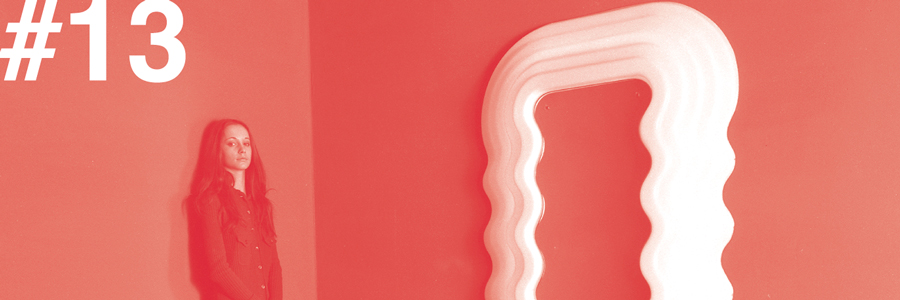
The Ultrafragola mirror is the only piece in Ettore Sottsass’s Mobili Grigi series that was actually produced. All the others were made only in limited numbers. The words used by Sottsass to describe this series, with their «rounded and (permanently) swollen shapes of perhaps female or, if you like, religious origin (which is the same thing)», seem to reverberate, amplified, in its wavy frame lit up by pink neon. It was in May 1970 at Eurodomus 3, the forerunner of what would become Milan’s Salone del Mobile, that Poltronova presented this series made from fiberglass, which was a material commonly used for boat hulls but unusual in the world of design. The series bore the brand of the Design Centre, the division created a few years previously in Poltronova to market advanced technology designs.
The stand designed by Sottsass was a space in semi—darkness illuminated only by the neon lights that emerge from the furniture «like Japanese fireflies, which transform May nights into solid matter». The Mobili Grigi series of furnishings emerge from the darkness of this metaphysical space like alienating apparitions. Sottsass’s original idea was for three—dimensional contoured shapes fixed to the wall, but although the technology to make them this way didn’t exist at the time, it can clearly be seen in the Ultrafragola mirror.
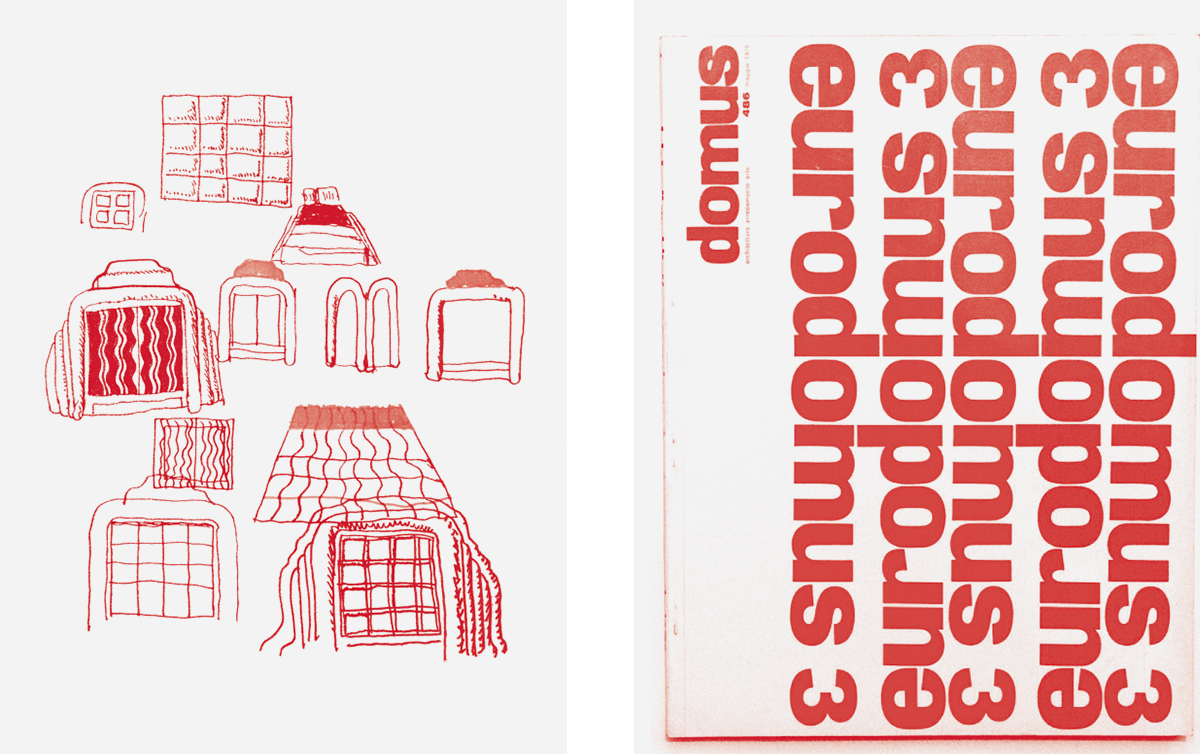
The third edition of Eurodomus, organised by “Domus” magazine and Torino Esposizioni, was held for the first time in Palazzo dell’Arte in Milan, after the two previous events in Genoa and Turin, and offered huge potential for international visibility. The reactions of the public and business insiders to Sottsass’s project were very strong. The position of “Abitare” magazine was emblematic of the general tone, criticising the Mobili Grigi series along the lines of “No, no, not this” and judging it to be in bad taste.
It wasn’t the unusual technology, or perhaps even the dark grey colour —chosen intentionally for its lack of commercial appeal— that disturbed the public so much as the fact that Sottsass used design, like art, as a tool for reflection, criticism and provocation. In Could anything be more ridiculous, in which he compares the Mobili Grigi and the Ceramiche Yantra (another design for Poltronova), Sottsass writes: «You need to put as many Mobili Grigi in a room as possible […]. At this point you feel almost suffocated by a brilliant grey geological sloughing of plastic […], you feel completely isolated from everything outside the room, as if you were in the burning red Monkey Temple in Benares, or in Captain Nemo’s submarine, or in the dusty grey Royal Tomb […] or on a silent journey through the solid black sky between Mars (the planet) and Orion (the star). It is a journey that is also a death, as is always the case if you are deeply immersed in reality. What more do you want?».
The photographs taken with Alberto Fioravanti, in which human presence is reduced to a fragment —a hand appearing from behind the bedhead, a leg poking out of a wardrobe, a woman with her head resting on the table— amplify this sense of searching for existential awareness.
The series includes the Elledue bed with its illuminated pink bedhead —later produced in sky blue too, and separately as the floor—standing lamp Elle— the Bicinque wardrobe capped by an illuminated yellow lampshade, the Unisex corner cabinet with two orange neon lights on either side of the vacuum—moulded doors, the three—shelf Essetre bookcase, the round Aromatico table, the Malatesta chair, the Ultrafragola mirror and the Piquattro record/magazine rack. The Bruco and Cometa lamps also form part of the same experiment.
Intentionally destabilising, there was no way the Mobili Grigi series could have been a market success, not even in the subsequent, mitigated, white version. This caused cracks to appear in the designer’s already delicate relationship with Poltronova. «The internal commission —writes Sottsass— told Cammilli that he had better stop spending money to produce more or less useless furniture like the designs I was proposing». So, in about 1973, Sottsass left the company because his work was too far ahead of the times to be accepted. The Ultrafragola mirror is the only remaining witness to the bold experimentation of the Mobili Grigi series, with the exception of a few rare and highly sought—after prototypes made of the other pieces.


